
 Dr Rafiya
  August 25, 2026

Quick Answer
Most UAE SME owners start with the wrong question: “Which insurer offers keyman insurance?”
The more useful question is: “What business risk am I actually trying to protect?”
Keyman insurance, also called key person insurance, can be one part of the answer. But it usually works best as one piece of a wider review that also looks at business loans, shareholder exposure, payroll continuity, family liquidity and first 72-hour business continuity.
This checklist is designed to be worked through before you compare providers, not after.
What Is Keyman Insurance?
Keyman insurance is a policy usually arranged around a person whose sudden death, critical illness, or long-term inability to work could materially affect the business, subject to policy terms and insurer underwriting.
The “key person” is not always the most senior title on the organisation chart. It is usually whoever the business is most exposed to. This may be:
- the founder or managing partner
- a senior doctor or clinical lead in a medical practice
- the main revenue generator or client relationship holder
- a technical specialist whose knowledge is not documented elsewhere
- a shareholder whose absence could trigger a buyout or valuation dispute
Keyman insurance differs from personal life insurance in one important way: the purpose, the policy owner and the beneficiary may be structured around the business rather than the family.
Getting that structure wrong is one of the more common and more costly mistakes SME owners make. This is why key person risk usually deserves a review before a quote, and why it is worth reading alongside our broader guide to key person insurance for UAE business owners.
Why UAE SMEs Should Review This Before Choosing Cover
UAE SMEs tend to be owner-led and relationship-led. One person often carries the bank relationship, the key client accounts, supplier terms and the day-to-day decisions that keep the business moving.
That concentration is normal. But it also means the sudden loss or incapacity of that person can create pressure on several fronts at once:
- bank confidence and existing loan or guarantee arrangements
- payroll and supplier payments in the weeks that follow
- client relationships that may not be documented or shared
- shareholder or partner arrangements, if ownership needs to change hands
- the family’s own income, if it depends on business cash flow
A policy chosen without reviewing these first can end up mismatched to the actual exposure. It may cover a headline number, but not solve the liquidity problem the business would actually face.
The Founder Dependency Test
Before discussing cover amounts, most SME owners should answer these questions honestly:
- Could the business run for 30–90 days without the founder actively involved?
- Who is authorised to speak to the bank if the founder is unavailable?
- Who controls the key client relationships day to day?
- Who can approve payroll and supplier payments in the founder’s absence?
- Who understands pricing, margins and existing contracts well enough to keep operating?
- Is there a genuine second-in-command with real authority, or only on paper?
- Does the founder’s family depend on business income for living costs?
- Are key documents, bank details, policies and adviser contacts accessible to someone else?
- If the founder is an NRI, are UAE and India-side obligations coordinated anywhere?
- Is there a First 72 Hours Continuity Map in place, or would the first few days be improvised?
This is a diagnostic exercise, not a sales exercise. Where the answers point to real gaps, that is the starting point for deciding what kind of cover, and how much, actually makes sense.
Business Loans and Bank Exposure
SME owners with loans, guarantees, overdrafts, trade finance or working-capital facilities carry a specific version of this risk. The lender’s confidence, and sometimes the loan terms themselves, may be tied to that person remaining involved in the business.
Keyman insurance may support business loan risk planning where the business or lender has real exposure to the loss of a key person.
Any assignment of the policy, beneficiary structure, lender requirement or security arrangement should be reviewed directly with the insurer, the lender and the business’s own legal and financial advisers. This is not something to structure informally.
Payroll, Rent and Supplier Pressure
The immediate issue after losing a key person is rarely one single large payment. It is the accumulation of smaller, recurring payments that do not pause.
These may include:
- salaries
- rent
- supplier invoices
- utilities
- loan instalments
- professional fees
- interim leadership or replacement hiring costs
Keyman cover is best thought of as a liquidity tool that buys the business time to adjust. It is not a complete business-continuity solution on its own.
The First 72 Hours Continuity Map should sit alongside it and map what cash the business and family can access, who can act, and what decisions must be made immediately.
Shareholder and Partner Risk
Where a business has more than one shareholder, the loss or incapacity of a partner can raise separate questions.
For example:
- Who inherits the shareholding?
- Can the remaining partners afford to buy it out?
- How will the value be calculated?
- Will the family need liquidity?
- Will the surviving shareholders have control and continuity?
This usually touches on partner protection, shareholder protection, buy-sell funding and ownership transfer and succession and exit strategy planning. It should be coordinated directly with the shareholder agreement and reviewed with a qualified legal adviser.
Clarity does not provide legal conclusions on shareholder agreements. That review sits with the client’s legal adviser.
Company-Owned vs Personal Cover
At a high level, three things need to line up: who owns the policy, who pays the premium, and who the beneficiary is. All three should match the actual planning objective.
Personal life cover usually protects the family.
Company-owned key person cover usually supports the business.
Shareholder or buy-sell planning may call for a different structure again.
Getting this wrong does not only cause administrative problems. It can mean the payout lands in the wrong place at the moment it is needed most. This is a structuring question for the insurer and legal adviser, not something to assume by default.
Provider selection should come after the business exposure is clear. Insurer options, policy type, ownership, beneficiary, assignment and underwriting depend on the company profile, insurable interest, financial justification, medical underwriting and provider terms.
Not sure what the actual liquidity gap in your business is?
A First 72 Hours Liquidity Review looks at founder dependency, loans, payroll and shareholder exposure before any provider conversation.
How Much Keyman Insurance Should a UAE SME Review?
There is no single formula. Any figure quoted without reviewing the business first should be treated with caution.
The sizing conversation usually draws on:
- outstanding business loans and guarantees
- 6–12 months of payroll and fixed expenses
- the realistic cost of replacing or interim-hiring for the role
- revenue and gross profit tied directly to the key person
- potential shareholder buyout exposure
- the family’s own income needs
- how long the business would realistically need to stabilise
- existing cover already in place
- accessible cash reserves
- what the relevant insurer’s underwriting capacity allows
For businesses with substantially higher protection or liquidity requirements, Jumbo Life Insurance may also be worth considering, depending on the business, family and succession objectives.
The number should reflect the actual liquidity gap in the business, not simply a multiple of the key person’s salary.
Documents That May Be Needed
Requirements vary by provider and case size, but SME owners may be asked for some combination of:
- trade licence
- shareholder details
- financial statements and management accounts
- loan or facility details
- business ownership documents
- an explanation of the key person’s role
- details of existing cover
- medical and financial underwriting information
- board or company approvals, where required
Having these ready before approaching a provider usually shortens the process considerably.
Common Mistakes Before Choosing Keyman Insurance
- starting with premium instead of the underlying exposure
- asking “which insurer?” before understanding the risk
- choosing a cover amount without mapping the liquidity gap
- getting the policy owner or beneficiary wrong
- leaving the policy disconnected from the shareholder agreement
- overlooking existing business loans
- overlooking the family’s own liquidity needs
- underestimating replacement or interim-hiring cost
- assuming approval is guaranteed before underwriting
- confusing personal cover with company-owned cover
- never reviewing cover that is already in place
- having no First 72 Hours Continuity Map to sit alongside the policy
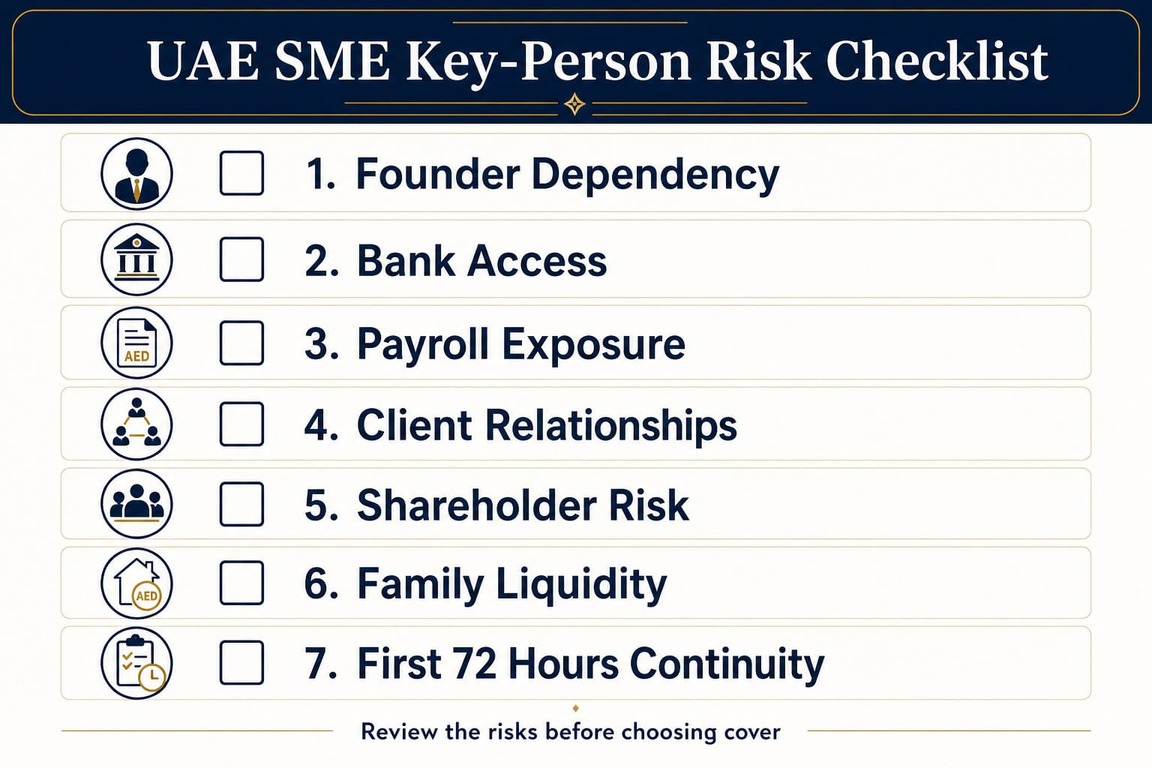
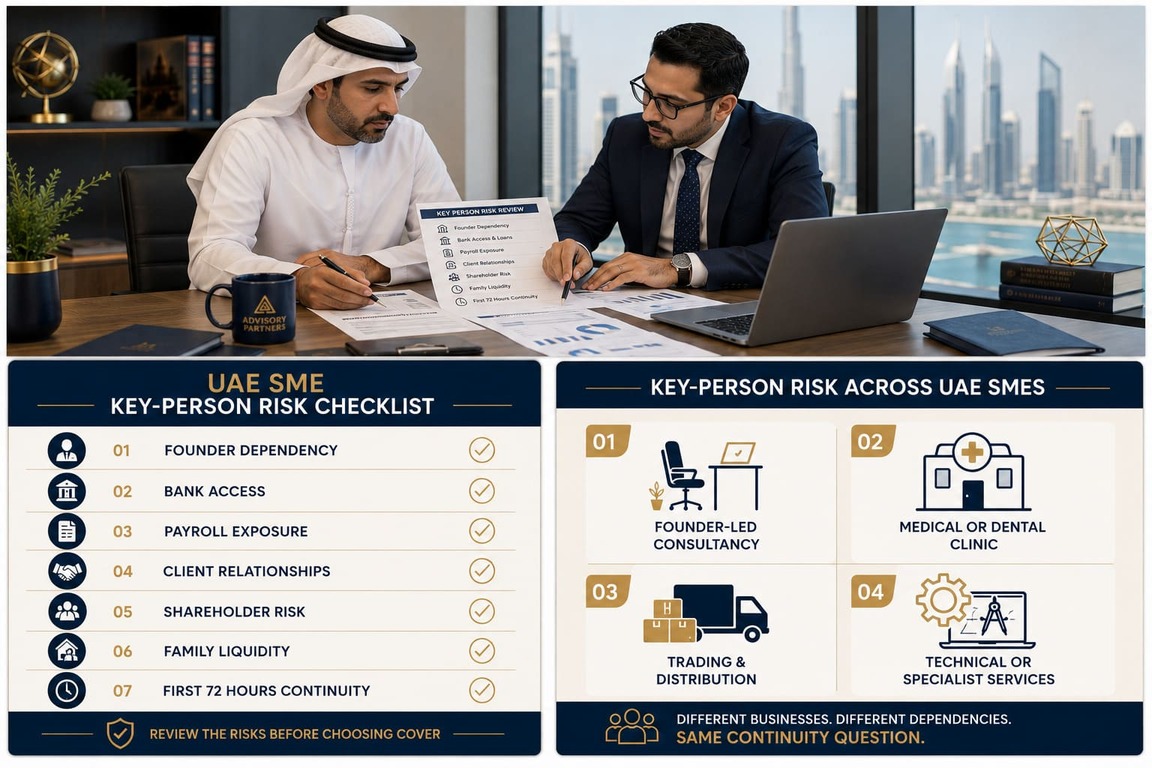
UAE SME Key-Person Risk Checklist
A review is usually worth having if any of the following are true:
- One founder controls the major client relationships.
- The business has loans, guarantees or banking facilities in place.
- Payroll depends heavily on one person’s revenue or decisions.
- There is no clear second-in-command with real authority.
- The business has partners or shareholders.
- The founder’s family depends on business income.
- The business would lose meaningful value if one person became unavailable.
- There are UAE–India or other cross-border obligations to coordinate.
- Existing life cover is personal only and has never been reviewed against the business.
- There is no First 72 Hours Continuity Map in place.
This checklist is a starting point for a conversation, not a recommendation for any specific product.
Keyman Insurance for Different UAE SME Types
Founder-Led Consultancy or Professional Firm
Exposure usually centres on client relationships, revenue concentration in one or two people, bank confidence and the ability to deliver ongoing projects without disruption.
Medical, Dental or Aesthetic Clinic
Exposure usually centres on dependence on the lead doctor, patient trust and continuity of care, treatment revenue, and the practice’s ability to keep operating and financing equipment or staff.
Trading or Distribution Business
Exposure usually centres on supplier relationships, credit terms, receivables, bank facilities, sales relationships and keeping logistics running without interruption.
Technical or Specialist Service Business
Exposure usually centres on technical knowledge that sits with one person, project continuity, how easily that specialist role can be replaced and the risk of client delivery being disrupted.
Independent Review Before Product Selection
Clarity Financial Consultancy starts with your situation, not with a product.
We review your family, business, liquidity, continuity and cross-border needs before discussing provider options. The goal is to understand the actual problem first — whether that is family protection, business continuity, key-person risk, estate liquidity, succession funding, retirement planning or UAE–India coordination.
We are not tied to one product route. Where insurance or investment solutions are considered, we help you review suitable options, provider terms, charges, ownership structure, beneficiary arrangement and implementation route before any decision is made.
Book a First 72 Hours Liquidity Review
Before comparing keyman insurance providers, it usually helps to review the business exposure first. A First 72 Hours Liquidity Review helps UAE SME owners review founder dependency, key-person risk, business loans, payroll exposure, shareholder risk and family liquidity before any provider conversation begins.
 Chat with Dr Rafiya on WhatsApp
FAQ
What is keyman insurance in the UAE?
Is keyman insurance the same as key person insurance?
Who needs keyman insurance in Dubai?
What does keyman insurance cover?
Who owns and receives a keyman insurance payout?
How much key person insurance does a business need?
Can a startup or SME get keyman insurance in the UAE?
Is keyman insurance useful for a business loan?
Does keyman insurance cover critical illness or disability?
How is keyman insurance different from shareholder or buy-sell protection?
How do I insure the key partners of a small firm in Dubai?
Compliance Disclaimer
Clarity Financial Consultancy provides education, review and planning support. Product suitability, policy ownership, beneficiary structure, premiums, exclusions and approval depend on the client’s individual circumstances, insurer underwriting and provider terms. Shareholder, succession, tax, lending and legal matters should be reviewed with appropriately qualified professionals.